
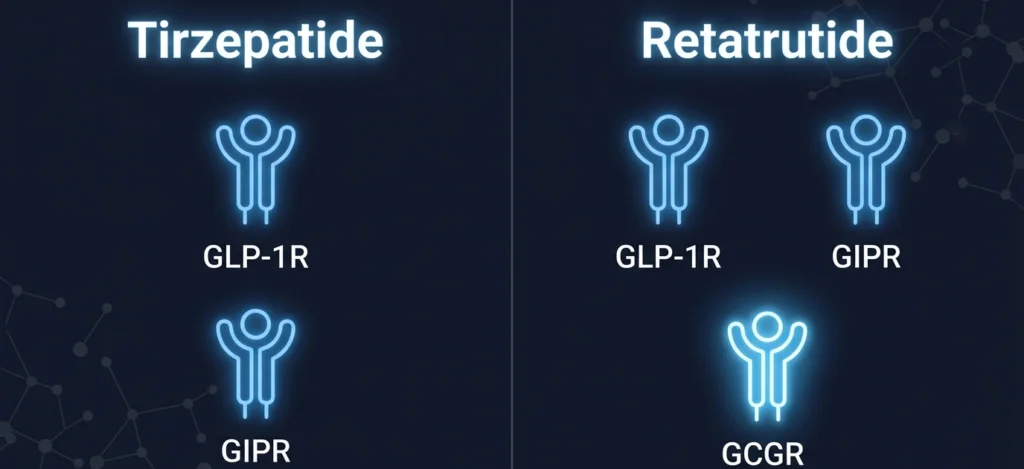
Retatrutide vs tirzepatide comes down to one receptor. Tirzepatide is a dual GLP-1/GIP agonist, while retatrutide extends that profile by also engaging the glucagon receptor (GCGR), making it a triple agonist. That third receptor pathway is what researchers are most focused on when comparing the two compounds, and it has meaningful implications for the metabolic outcomes each compound produces in experimental models.
Both compounds have attracted significant attention in the research community, and both are relevant subjects for investigators working in GLP-1 pharmacology, obesity models, and metabolic disease. This comparison covers the receptor profiles, mechanisms of action, and current clinical data for each, with the goal of giving researchers a clear framework for evaluating which compound is most relevant to their study design.
| Feature | Tirzepatide | Retatrutide |
|---|---|---|
| Receptor Targets | GLP-1R, GIPR (dual) | GLP-1R, GIPR, GCGR (triple) |
| Thermogenic Effect | Limited | Yes — via GCGR |
| Hepatic Effects | Minimal | Yes — NAFLD models |
| Clinical Stage | FDA approved | Phase 3 (ongoing) |
Receptor Profile: Dual Agonist vs Triple Agonist
The foundational difference between retatrutide and tirzepatide is the number and type of receptors each compound engages. Tirzepatide simultaneously activates GLP-1R and GIPR, a dual agonist approach that represented a meaningful step beyond single GLP-1 receptor agonists when it entered clinical development. Its trial data has consistently reflected that incremental receptor engagement, with outcomes exceeding those of earlier single-pathway compounds across multiple study populations.
Retatrutide extends this framework by adding GCGR agonism on top of the GLP-1R and GIPR engagement that tirzepatide already provides. The glucagon receptor is the distinguishing variable between the two compounds. Its activation introduces a thermogenic dimension and hepatic effects that are structurally absent in tirzepatide’s dual-receptor profile, giving retatrutide a broader metabolic footprint than any currently approved peptide in the GLP-1 class.
From a research design standpoint, this distinction is significant. Studies comparing receptor co-agonism effects, thermogenesis, or hepatic fat metabolism will find retatrutide’s tri-agonist profile uniquely suited to those questions in a way that tirzepatide’s dual mechanism is not.
Mechanism of Action Comparison
Tirzepatide
Tirzepatide’s dual GLP-1/GIP mechanism drives glucose-dependent insulin secretion, appetite suppression via central nervous system pathways, and adipose tissue signaling through GIPR engagement. Its extended half-life supports once-weekly administration, and its mechanism has been thoroughly characterized across completed Phase 3 clinical programs. The compound’s effects on body weight, glycemic control, and cardiovascular risk markers are well documented in peer-reviewed literature and represent the current benchmark in dual-agonist peptide research.
Retatrutide
Retatrutide’s mechanism encompasses everything tirzepatide does and layers in the effects of glucagon receptor agonism. GCGR activation is associated with increased hepatic glucose output and elevated basal metabolic rate, a thermogenic effect that researchers have identified as one of the most pharmacologically interesting aspects of the triple-agonist approach.
The co-presence of GLP-1R agonism plays a critical balancing role here. In isolated glucagon stimulation, hyperglycemia is a known risk. Within retatrutide’s tri-agonist framework, GLP-1R engagement counteracts that risk by driving glucose-dependent insulin secretion, allowing the thermogenic and hepatic effects of GCGR activation to proceed without destabilizing glycemic control. Researchers have described this as a pharmacologically complementary relationship among the three receptor pathways, and it is central to understanding why the triple-agonist design is considered a step beyond tirzepatide rather than simply an additive modification.
The net result in early research models is a compound with a broader and more complex metabolic footprint than tirzepatide, with particular implications for studies focused on energy expenditure, hepatic metabolism, and multi-pathway receptor signaling.
Comparative Research Data
No direct head-to-head clinical trials between retatrutide and tirzepatide have been published. Comparisons draw from each compound’s separate trial programs and should be interpreted with that methodological context in mind.
Tirzepatide Clinical Record
Tirzepatide has completed Phase 3 evaluation with results published across multiple peer-reviewed journals and has received FDA approval for type 2 diabetes and obesity indications. In obesity research settings, tirzepatide demonstrated substantial body weight reductions over 72-week study periods, surpassing outcomes previously observed with GLP-1 single agonists. Its tolerability profile is well established, its safety data is extensive, and its long-term outcomes data makes it one of the most thoroughly characterized peptide compounds currently available for comparative research.
Retatrutide Clinical Record
Retatrutide Phase 2 data, published in The New England Journal of Medicine, reported weight reduction outcomes over 48 weeks that in higher-dose cohorts appeared to exceed those observed with dual-agonist compounds in comparable study designs. Secondary metabolic markers including triglycerides, fasting insulin, and waist circumference showed favorable directional changes across trial arms. Preclinical models also demonstrated reductions in liver fat accumulation in NAFLD settings, an area of investigation that falls outside tirzepatide’s primary clinical focus.
Phase 3 trials are currently underway under Eli Lilly’s TRIUMPH development program, with topline data from TRIUMPH-4 released in late 2025 and additional results anticipated through 2026. Retatrutide has not received regulatory approval for therapeutic use in any jurisdiction. Its clinical dataset, while compelling, is less mature than tirzepatide’s at this stage of development.

Retatrutide vs Tirzepatide: Which Is Relevant for Your Research?
The choice between retatrutide and tirzepatide for research purposes depends on the specific questions a study is designed to answer. Tirzepatide is the better-characterized compound with a mature clinical record, making it well suited for studies that require a stable reference point in dual-agonist GLP-1/GIP pharmacology, or for comparative work against established FDA-approved benchmarks.
Retatrutide is the stronger choice for researchers specifically interested in the effects of glucagon receptor co-activation, tri-agonist signaling dynamics, thermogenesis, hepatic fat metabolism, or the pharmacological interaction between GLP-1 and GCGR pathways. Its emerging Phase 3 dataset also makes it relevant for investigators tracking the clinical development of next-generation metabolic peptides.
For studies that require both compounds, sourcing research-grade supply with verified purity and independent third-party COAs is essential. Pepthrive provides research-grade retatrutide with third-party verified purity for use in qualified laboratory settings. For a deeper look at retatrutide’s mechanism on its own, see our full retatrutide research guide.
| [ WORDPRESS CTA BLOCK — PEPTHRIVE ] Dark navy callout box. Text: ‘Sourcing retatrutide for your research? Pepthrive provides third-party verified, research-grade retatrutide with fast US shipping.’ Include ‘Shop Retatrutide’ button linking to product page. |
What is the main difference between retatrutide and tirzepatide?
Tirzepatide is a dual GLP-1/GIP receptor agonist. Retatrutide adds a third pathway, glucagon receptor activation, making it a triple agonist. This additional GCGR engagement introduces thermogenic and hepatic effects that are absent in tirzepatide’s dual mechanism, giving retatrutide a broader metabolic profile in research models.
Is retatrutide more effective than tirzepatide?
No direct head-to-head trials have been published. Phase 2 data for retatrutide showed weight reduction outcomes that appeared to exceed those of dual-agonist compounds in comparable study populations, but retatrutide’s Phase 3 dataset is still emerging while tirzepatide has a fully mature clinical record. Researchers should interpret comparisons with that methodological context in mind.
Is retatrutide FDA approved?
No. Retatrutide is currently in Phase 3 clinical trials and has not received FDA approval for therapeutic use in any jurisdiction. It is available as a research-grade compound for laboratory use by qualified professionals. Tirzepatide has received FDA approval for type 2 diabetes and obesity indications.
Can retatrutide and tirzepatide be used together in research?
Comparative protocols using both compounds are a legitimate area of research inquiry, particularly for studies examining the incremental effects of adding GCGR agonism to a dual GLP-1/GIP framework. Sourcing both compounds from suppliers with verified third-party purity documentation is essential for maintaining experimental reproducibility across batches.
Where can researchers source retatrutide for laboratory studies?
Pepthrive supplies research-grade retatrutide with third-party verified purity and batch-specific Certificates of Analysis. All products are intended strictly for laboratory research use by qualified professionals in research settings.
Leave a Reply